Central Banking, Monetary Policy, and the ECB: Coping with the Challenges
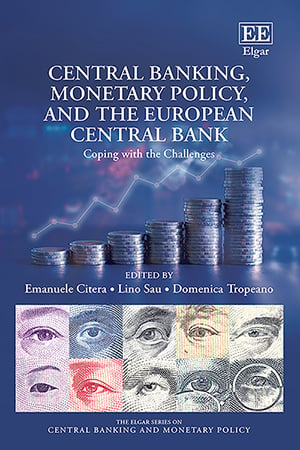
At the heart of this book is a simple but powerful question: Is the ECB well-equipped to handle the current crises and the upcoming challenges?
Conventional wisdom suggests that the central bank should focus on what it can control, namely the price level, which would ultimately promote financial stability. This idea, which we refer to as the “original sin”, has been inherited from the German model of central banking. Unlike the Anglo-French tradition, where the central bank balances multiple goals such as employment, growth, and financial stability, the ECB was built to prioritize one thing above all else—keeping inflation low. This model was seen as guaranteeing independence from political pressures. Yet, this design has a major weakness.
By focusing too narrowly on inflation, the ECB underestimated risks to financial stability—the health of banks, credit markets, and government debt. The 2008 financial crisis revealed that stable prices do not automatically mean a stable economy. In fact, during the housing bubble and credit boom of the 2000s, inflation remained low, so the ECB saw little reason to act, even as dangerous imbalances built up. When the bubble burst, Europe faced recession, bank failures, and government debt crises that threatened the very survival of the euro. The lesson is clear: price stability does not guarantee financial stability. And when the two goals come into conflict, the ECB lacks the tools and mandate to deal with both effectively.
Despite these shortcomings, the ECB has shown remarkable adaptability. One turning point was the Outright Monetary Transactions (OMT) program announced in 2012, when former president Mario Draghi pledged to do “whatever it takes” to save the Euro. By promising to buy unlimited amounts of government bonds, the ECB reassured markets and prevented the collapse of the Eurozone. Importantly, the program worked largely by changing expectations—very few bonds were actually bought, but the commitment itself stabilized markets. This marked the ECB’s evolution into a lender of last resort for financial institutions and governments – a principle developed by Walter Bagehot in his 1873 book Lombard Street, according to which a central bank should lend freely, at a high rate of interest, and against good collateral during times of heightened financial distress.
Later programs, including those introduced during the COVID-19 pandemic, further expanded its toolkit. In 2021, the ECB also formally updated its strategy, acknowledging the importance of financial stability and climate change alongside price stability. However, we argue that these changes have often been ad hoc responses to emergencies rather than part of a fully coherent framework.
Given this framework, the book discusses several ongoing challenges for the ECB, which are addressed in detail in three main sections. The first one explores the theoretical and institutional foundations of the ECB and how it has responded to crises. The chapters in this part debate whether its focus on inflation has blinded it to deeper problems, and whether reforms such as a Euro Treasury or stronger fiscal cooperation are needed. The second section deals with climate change and monetary policy, examining how monetary policy could support the green transition without losing focus on price stability and whether the ECB’s mandate should be rewritten to include environmental objectives. Even though debates continue over whether the ECB mandate should be formally expanded, the consensus is that climate change cannot be longer ignored. Finally, the last section discusses issues related to banking and financial systems, focusing on Europe’s payment systems, the role of public banks, and the risks in the interbank market. It argues for reforms to strengthen financial stability and reduce vulnerabilities that could trigger possible future crises.
In conclusion, the central message of the book is that the ECB should embrace a broader role, one that includes financial stability, cooperation with fiscal policy, and responsiveness to climate change. If price stability remains the main target, the ECB is at risk of repeating old mistakes. This is not just a technical issue for economists. It impacts democracy, asymmetries between northern and southern member states, and the future direction of the European project itself.
Readers looking to purchase a copy of Professor Citera’s new book can do so using this link.