Sanctions: Wars Without Bullets
The word “sanctions” has firmly established itself in the lexicon of a Western household in the recent years, specifically after the escalation of the conflict between Russia and Ukraine in February 2022, yet remains to the general public a murky and loaded term. Google Trends for the term “sanctions” shows the highest relative searches in February 2022, as shown in Figure 1, after the leaders of other countries responded to Russia’s military troops entering Ukraine by imposing a host of sanctions on Russia. Still, the popular understanding of what sanctions are, their mechanism, their imposition, and their removal is nebulous. In this article, I aim to shed some light on the basics of this widely used policy and dive into some issues that inevitably arise when we discuss sanctions.
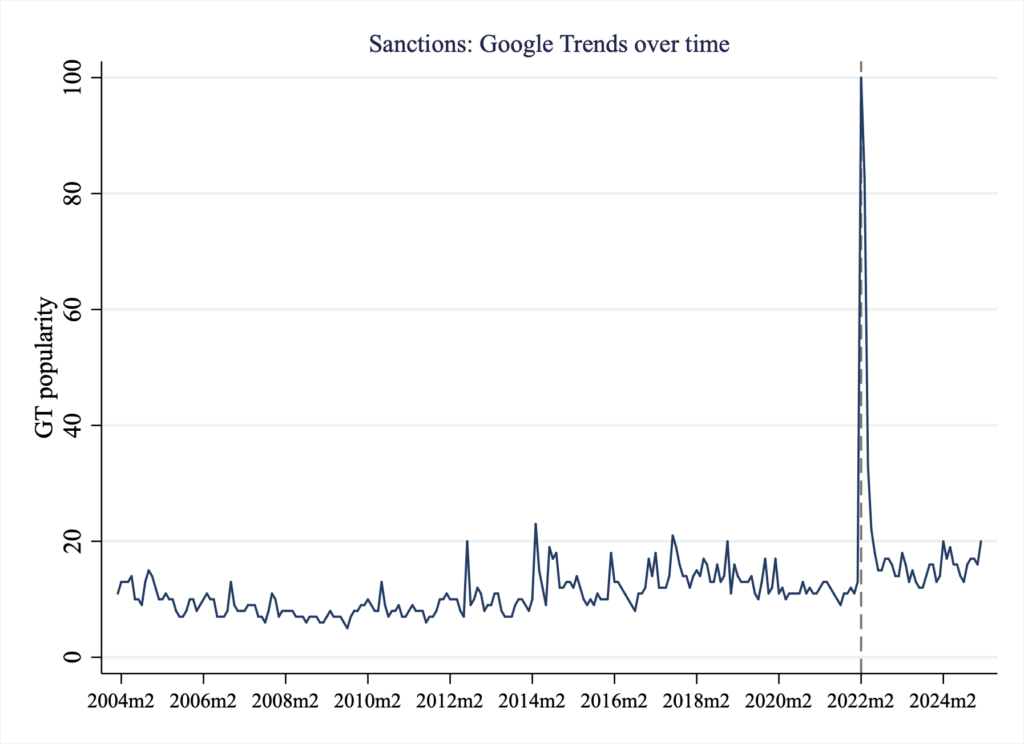
Fig 1. Source: Google Trends, term “sanctions”. Plot created by the author.
Sanctions are restrictive measures applied by a sender and designed to pressure the target to change its behavior. They can take a variety of forms, but generally are divided into two broad categories: (1) target sanctions that apply to individuals or entities (for example, officials or businesspersons who have ties to the target country’s military and defense industries), and have been increasing in popularity, and (2) industry-wide sanctions that apply to sectors of the target nation’s economy. Target sanctions include such measures as travel restrictions like visa bans, asset freezes, and business activity restrictions for citizens and officials from the target country. Industry-wide sanctions include arms and dual equipment embargoes, restrictions on exports and/or imports, and financial measures: e.g., Russian banks were disconnected from the global SWIFT system, which is crucial for facilitation of international monetary transactions.
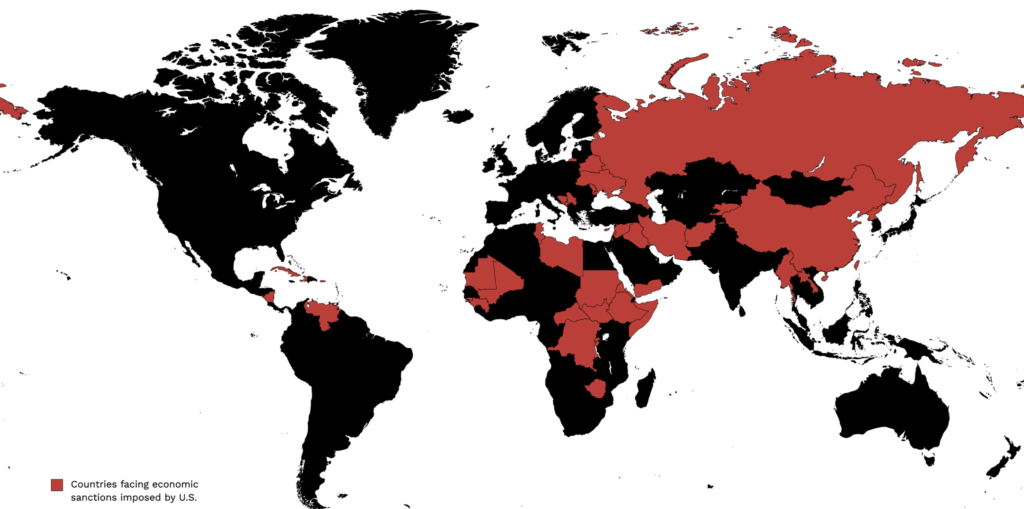
Sanctions can be unilateral, which means they are applied by a single country (like the US, which applies sanctions frequently and liberally), or multilateral, which in the academic literature strictly refers to sanctions imposed by the United Nations but can also refer to sanctions imposed by multiple senders (like several countries). Multilateral sanctions, are more difficult to impose because they require multiple agents to agree on a course of action. For example, for the European Union to impose sanctions, countries must agree unanimously on the policy, making their imposition more difficult. This difficulty is also why the UN has not imposed sanctions on Russia after the escalation of conflict in Ukraine: Russia has veto power at the United Nations Security Council and wouldn’t vote against its own interest. Unilateral sanctions are thus more prominent than multilateral, although both have been increasing in number in recent decades, as can be seen in Figure 2.
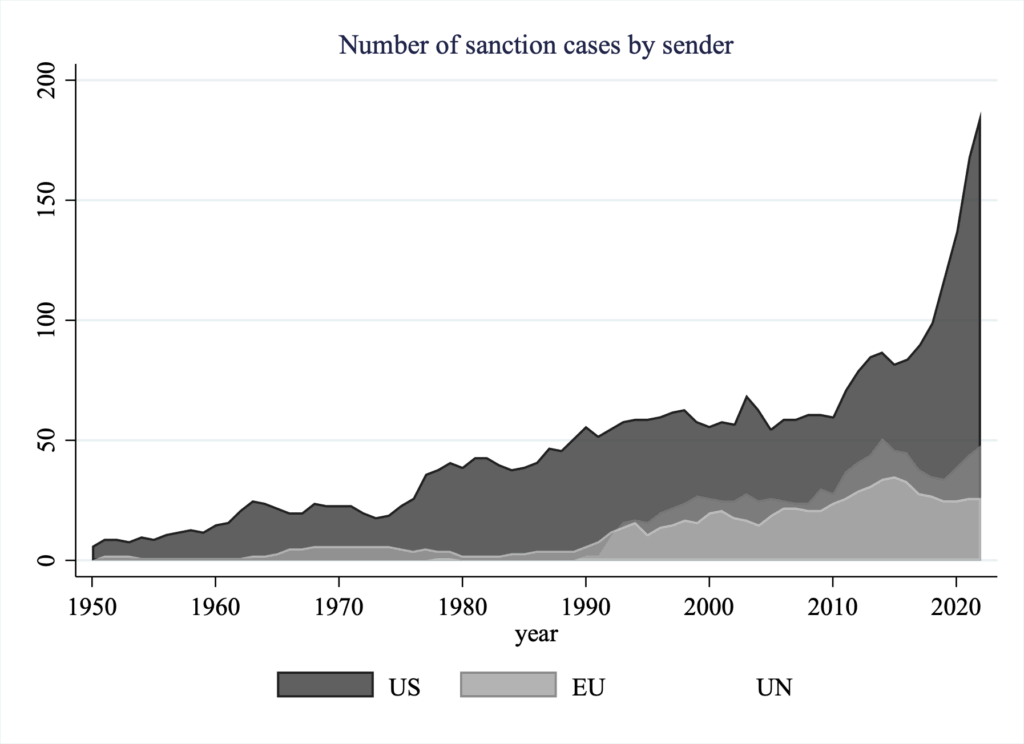
Fig 2. Source: author’s calculations using the Global Sanctions Database (GSDB)
Typically, sanctions are imposed in response to a transgression committed by the target nation, individual, or entity. GSDB separates sanctioning objectives in 8 categories: policy change, prevent war, end war, protection of human rights, protection of democracy, combating terrorism, destabilize the regime, resolution of territorial conflict, and other. To illustrate objectives of sanctions, consider three following cases. First, international community-imposed sanctions on South Africa during 1960-1980s in response to its apartheid policies; second, the Cuban embargo was imposed by the US in 1960 with the hopes of thwarting the spread of communism; thirds, the sanctions were imposed on Russia after 2014 annexation of Crimea and 2022 after the escalation of the conflict.
While the sanctions against South Africa succeeded in the removal of the apartheid policies, the Cuban embargo and Russian sanctions have not achieved their goal. This leads us to one of the bigger questions about sanctions: their effectiveness. Figure 3 uses the classification of sanctioning objectives presented in GSDB, to demonstrate the sanctions’ effectiveness, proxied by the success of reaching their objective. In the majority of cases, the sanctions either failed to meet their objective or are ongoing.
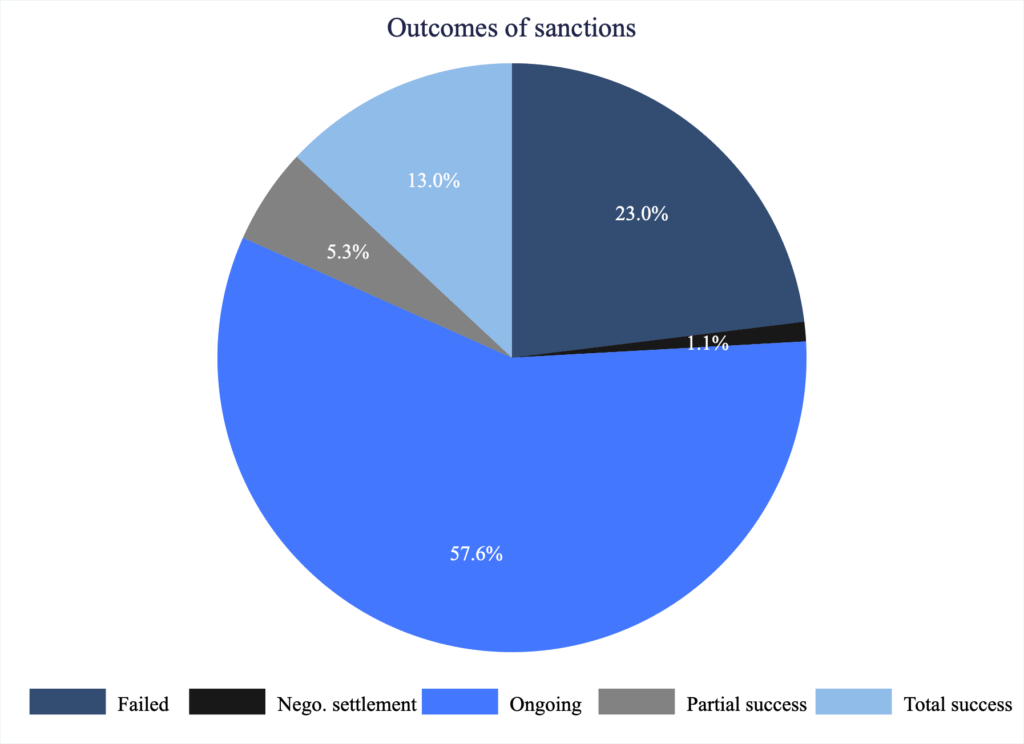
Fig 3. Source: author’s calculations using the Global Sanctions Database (GSDB); 6 of the 8 most common objectives are presented
What exactly is meant by the “effectiveness” of sanctions differs based on who is asked. Most commonly, an effective sanction is understood as one that achieves its objective. For example, the sanctions against Russia imposed in 2022 would be considered effective if Russia withdrew its troops from occupied Ukrainian territories. The reality, though, is that how effectiveness is defined and understood is frequently more nuanced than just whether the objective was achieved.
Consider a case when sanctions are resolved in a compromise or a negotiated settlement, such that some objectives might not have been achieved or might have been replaced by another objective. Does this reduce the effectiveness of sanctions? Another question is purely economic: how costly are sanctions, including their unintended consequences (see for example Miromanova (2023)), and how do these costs compare to the benefits of the resolution? Even if the sanctions do not achieve their objective, how much more destructive could the target’s behavior have been? These layers of complexity mean that sanctions tend to be imposed even though the general sentiment in the academic literature and public discourse on sanctions is that they are not very effective.
Even if there is not a universally accepted definition of sanctions, there are several factors that impact whether sanctions achieve their objectives (Hufbauer et al (2009)). Among these factors are (1) the political regime of the target country, (2) the objectives, (3) the cost, (4) the duration, and (5) enforcement. Democratic countries are more likely to comply with demands than more authoritarian regimes, which leads to faster removal of sanctions (Lektzian and Souva (2007). Sanctions with more reasonable objectives are more likely to succeed: for example, curbing human rights violations is easier than regime change. Sanctions may be costly to both the sender and the target. The longer sanctions stay in place, the more room the target has for adjustment and thus the less effective they may become. Finally, sanctions are extremely difficult to enforce. While unilateral sanctions are easier to enforce, multilateral sanctions pose more challenge. For example, Russia reportedly continues to service North Korean ships in its ports despite officially complying with UN sanctions (Miromanova (2022)).
Sanctions are much easier to impose than they are to remove, which is why the majority of sanction cases are still ongoing, as can be seen in Figure 4. Once sanctions are in place, they can be removed if the target complies, which is rare (about half of the cases, according to Attia et al (2020), or the sender capitulates. Capitulation can be seen as negative by a median voter in the sender country and is also rarely practiced, which is another reason why sanctions mostly remain in place. In the background of ongoing sanctions, senders and targets adjust, create new alliances, and reach new economic equilibria.
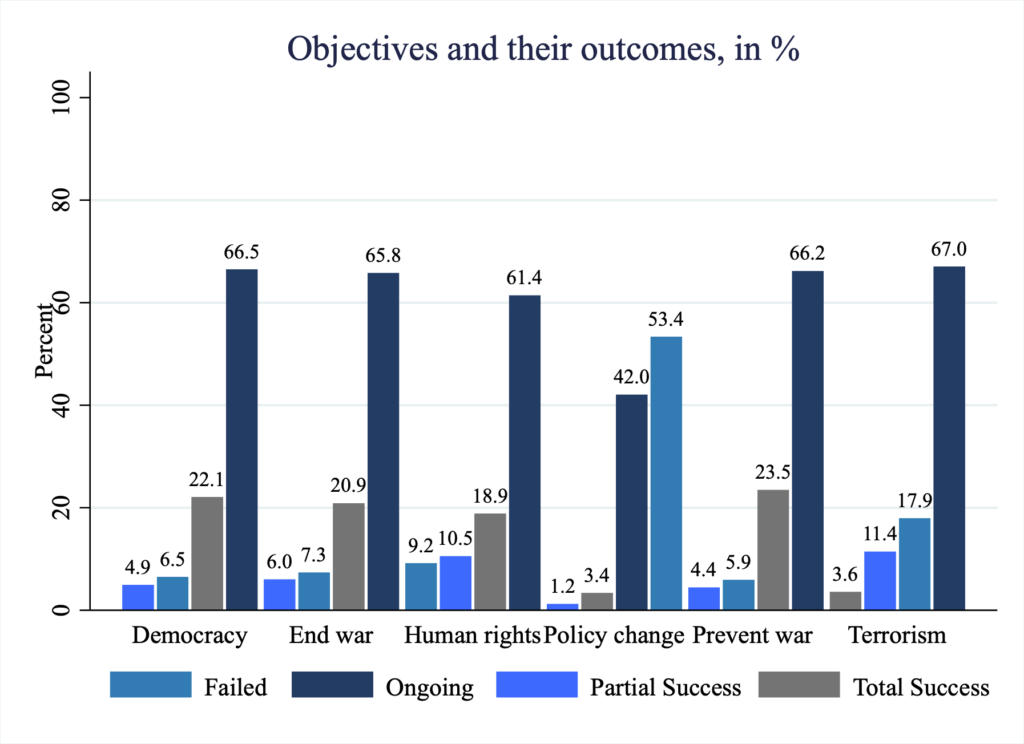
Fig 4. Source: author’s calculations using the Global Sanctions Database (GSDB); proportion of all sanction cases by outcome
References
Attia, H., Grauvogel, J., & von Soest, C. (2020). The termination of international sanctions: Explaining target compliance and sender capitulation. European Economic Review, 129, 103565.
Hufbauer, G. C., Schott, J. J., Elliott, K. A., & Oegg, B. (2009). Economic sanctions reconsidered (3rd ed.). Peterson Institute for International Economics.
Lektzian, D., & Souva, M. (2007). An institutional theory of sanctions onset and success. Journal of Conflict Resolution, 51(6), 848–871.
Miromanova, A. (2022). Russia’s approaches to multilateral sanctions. In A. Charron & C. Portela (Eds.), Multilateral sanctions revisited: Lessons learned from Margaret Doxey (pp. 51–65). McGill-Queen’s University Press.
Miromanova, A. (2023). Sanctions and their impacts on medical trade and health outcomes. Review of International Economics. Advance online publication. https://doi.org/10.1111/roie.12700